




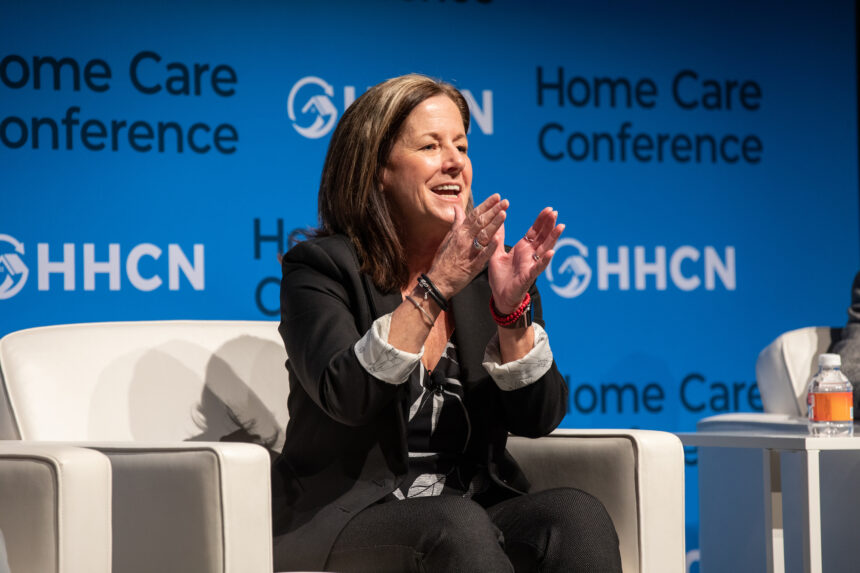
The CEO on the right at home, Margaret Haynes, plans to duplicate hours of the company weekly during the next decade as demand increases.
While seeking to fulfill its considerable growth plans for OMAHA, based in Nebraska at home, Haynes is also browsing what he sees as the “collision course” faced by the home care industry: demand for the roof and insufficient. To overcome this obstacle, home care providers can adopt innovation and support caregivers through the federal defense, said Haynes in the last episode of the spropt of home Health Care News.
Just at home offers company personal care and care services, with more than 750 franchise locations in the United States, Canada, the United Kingdom, Australia, Ireland and the Netherlands.
Haynes, who entered the Hol of the CEO in 2022, operates with a three -year strategic vision that focuses on four key pillars: supply, demand, quality and operational efficiency. He sat with HHCN to discuss each of these pillars and his vision for the company.
Duration of the conversation, Haynes also shared policy changes in the upper part of his mind, the strategy of AI directly at home and the benefits (and challenges) or operating under a franchise model.
Selections of that conversation are shown below, edited for length and clarity.
Subscribe to the interruption to be notified when new episodes are launched. Listen today at Apple Podcasts or Soundcloud.
HHCN: Where would you like to see right at home in five to 10 years?
Haynes: We want to continue touching as many lives as possible. At this time, weekly, only in the USA, we are doing about 473000 hours of attention a week. That is exciting. It is a large number, but I would love to see that 10 years. We know that it is so much demand that people will need our services. We are certainly focused on the expansion of the footprint, so that in those communities where we are not, we would love to bring the mission of law at home.
Our growth is around the footprint itself, but also each of the individual franchise offices. We are always working closely with them to continually help them grow their business, because they also want to touch as many lives as possible in their local communities.
Let’s talk a little more about the franchise model. What do you see how the greatest specific competitive advantages and challenges for the franchise model in the home care industry today?
One of the greatest benefits of the franchise model in general is the concept of: it can enter business by itself, but not by itself, so it is real with a franchise model … that gives it a lot of comfort.
The franchise as an industry itself is the backbone of small businesses throughout our economy. When observing the success rate of small businesses that begins through a versus franchise concept only a mother and pop type startup, the probabilities of success are higher due to best practices. From my perspective in the corporate office here, our whole goal is to help our franchise owners to build sustainable and profitable businesses. We are really focused on how we can help them do that.
However, there are pros and cons. Then, some of the challenges from a franchise perspective, if there are things that we need to change and others, sometimes that can take a little more time than if it were just an individual store. Some of the challenges may be that they are reaching the mentality of ‘I just want the brand. I really don’t care about everything that is linked to the franchise model. ‘That’s where the whole value is. So, sometimes, if soe is a malcript and really wandering to call all the shots and once they sign the agreement, they really do not compromise, that is not a good work model for any of the parties.
We do not think about that like us and them, because we are holistically here for everyone to succeed. But there may be challenges. We do not dictate, but we give suggestions and win the hearts and minds and know that we are aligned in our goals with our franchisees.
An important challenge for the home care industry is the high demand for services, but the limited supply of caregivers. How can suppliers address this problem?
We are in this collision course. The demand will be for the clouds, and there is no equal tax base behind them, of the workers and other things. When we look at caregivers who work today for the right brand at home, they cross a wide range of age groups. That gives us a great pool to choose from. Therefore, we have caregivers today can be boomers or perhaps traditionalists who have very good health and want to go back. Over the years, we have spoken, in some cases, for retirees, it is a way in which I can volume with a payment check. We have caregivers who go from 18, 19 and 20 years old who could go to the Nursing School … [to] Mothers whose children are now back at school and have a little more, retirees who have left great jobs and now just want to give back their communities.
But there will be enough caregivers, and that is where innovation will play a role. So, certainly from a federal defense perspective, there are things we are doing to support caregivers.
Speaking of how technology can support caregivers and return to their focus on innovation, how does AI use at home? What is your approach to AI in general?
We have had elements of infused in operational things in the last 10 years, but we recognize that it will only accelerate. In our three -year plan that we place in mid -2022, we decided to build a team, one that focuses on innovation. So, innovation around the business and innovation model around technology. Then separate, we were going to bring specific resources from AI. And then we now have talent in the organization in which everything they are thinking about is. Ai scares me in some aspects, but it also really excites me.
From an AI perspective, we have a couple of things that are infused in our technology that we use to program caregivers and clients and make it more efficient. We will continue using AI for things that are more repetitive in the office, because if you can do those repetitive things through an AI module, then it releases time for more things based on relationships, and our business at the end of the day is very based on the relationship. The longer we can focus on loving caregivers, staff and customers and their families, it is something wonderful.
But then the AI is also helping from a technological perspective, around how it is used at home. I believe that AI in the future will do how we, as individuals, are treated from a medical perspective. [different]. Instead of being treated and diagnosed with averages, they will understand us as individuals, very identified. That is also exciting.
What scares me is how bad it can come from AI. The scams that can happen, and the elderly are a very vulnerable population. But we are very focused on AI. Real we have an association with our local university here with an AI technology that they are developing that helps those who are suffering with COPD. There will be many new ways in which technology and the combination really improve the general experience of aging for all of us.
What potential or real policy changes are the most important thing for you at this time, in terms of what excites you and what worries you.
Just at home he is a member of the Association of Care of the Household of America, or Hcaoa, as commonly mentioned. I sit on the board and I have it for the past three years.
First, a great thanks to the 118th Congress. At the end of last year, they approved the Elizabeth de Elizabeth veterans veterans of Elizabeth of Elizabeth. Mainly, it now allows veterans to spend the same amount on non -institutional care that could in institutional care. Before … veterans received more benefits for institutional care than to stay at home. We said you have to put it in the same field of play. The home is where most people because they will be, and this change supports that choice. Supporting veterans in this way is something that matters deeply, and that legislation was a great victory.
There are several other initiatives for which we currently legalize those that facilitate care. A couple of bills have been introduced or reintroduced: the Credit Law for Care, the Law on Reduction of Costs for Caregivers and the Law of Home Care for the Elderly. We are also legalizing the Law for Improvement of Continuous Nursing Nursing, which aims to improve quality care for medically fragile children. Right at home does not deal with fragile doctors, but throughout our industry, that is something really important.
From an immigration perspective, [we are focused on] How can we make it easier for caregivers to enter the country, so we are asking the care to be added to Annex A, where nurses and some other key professions are listed, so that it can be easier to bring some quality caregivers complement this shortage of caregivers that we know is happening today and will continue to exactly in the future?
You also ask me about some things that perhaps we are not waiting, or what we are seeing. There are some elements around the business model itself. There is a leg an 80/20 rule that is discussed from time to time from a Medicare perspective and the medicaid perspective. We are always seeing reimbursement rates and always worries me when we have the governments involved in the economy of a business, because what is proposed to be not, no no, it is not that it cannot not, I cannot not really do not really do it so as not to build a profitable business. And we need companies to be profitable to stay in business. Those have leg challenges.
And then we know that it is a great pressure in our law programs at this time, and the government is trying to discover this mathematical problem, so we believe that home care is such an important party that we are present, so we are not Medicare. That is health at home, but we go to home health and we associate with them, so that home health does a great job to meet what the medicine program will provide, but that does not always meet the needs, and so to work, work, work, work, work, work to work to work to work, work to work to work to work to work to work, work to work and work to work, work, work, work, work, work to work to work to work to work to work to work to work to work to work to work to work to work to Work to work to work. What else do mom and dad need?