




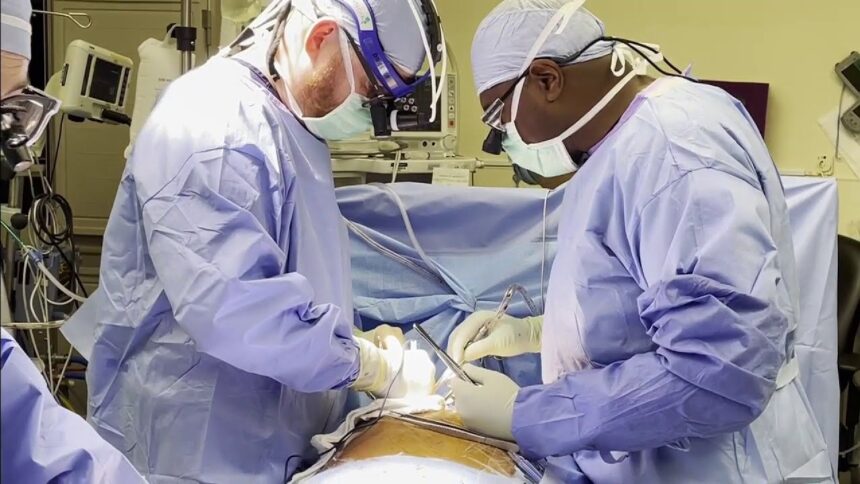
A Surgeon’s Leap Into Silicon Valley
In a sleek office overlooking Palo Alto’s tech corridor, a former trauma surgeon scrolls through real-time data from surgical robotics operating in hospitals across five continents. This is not a scene from science fiction. It’s the daily reality of Dr. Eric Monroe, a board-certified trauma surgeon turned MedTech entrepreneur, whose AI-powered surgical platform is transforming the global operating room.
As the founder and CEO of NeuroSurgica, Monroe has left behind the controlled chaos of the trauma bay for the calculated innovation of the startup world. But his mission remains unchanged: to save lives—only now, he does it with algorithms, robotics, and a startup that’s redefining precision surgery.
“I’ve stitched shattered arteries and stabilized fractured spines,” Monroe says. “But the system needed more than another steady hand. It needed scalable tools—and that’s what I set out to build.”
The Early Years: Surgery as a Calling, Technology as a Passion
Raised in Detroit, Monroe grew up in a working-class family that valued hard work and community service. His mother was a nurse, his father a machinist. From an early age, he was fascinated by the human body—and how machines could be used to repair it.
After graduating top of his class from Johns Hopkins School of Medicine, Monroe went on to complete a grueling trauma surgery fellowship at UCSF, where he became known not just for his skill with the scalpel but for his obsession with surgical data.
“While most surgeons left the OR and never looked back, I was downloading every second of footage and analyzing every hand movement.”
By 2018, he was running informal “surgery improvement labs” in the hospital basement, using video analysis and biometric feedback to help younger residents refine their technique.
The Turning Point: Frustration with a Flawed System
Despite his rising surgical career, Monroe couldn’t ignore a nagging problem: even in the best hospitals, surgical outcomes varied wildly depending on the surgeon, hospital, and available resources.
Then came a defining moment in 2019: a 42-year-old woman with a routine gallbladder removal died from a preventable surgical error in a rural hospital. The same operation in San Francisco, Monroe knew, would have taken 30 minutes and carried near-zero risk.
“That night, I knew the problem wasn’t skill—it was access. We weren’t democratizing surgical excellence. We were hoarding it.”
The next day, Monroe handed in his notice. By 2020, NeuroSurgica was born.
The Birth of NeuroSurgica: AI Meets Scalpel
Founded during the height of the COVID-19 pandemic, NeuroSurgica’s mission was bold: build an AI platform that could analyze, assist, and eventually guide surgeons in real-time—anywhere in the world.
Its core technology, SurgiMind, is a proprietary AI engine trained on tens of thousands of hours of surgical footage. Key features include:
- Real-Time Surgical Guidance – The AI alerts surgeons to potential anatomical risks in real-time.
- Haptic Feedback Integration – Surgeons receive subtle resistance or vibration cues through smart tools.
- Post-Op Analysis – Instant procedural review with personalized feedback loops for skill refinement.
- Remote Surgical Coaching – Senior surgeons can guide procedures across continents via augmented reality overlays.
SurgiMind doesn’t perform the surgery—it acts as a second brain, co-pilot, and teacher.
Clinical Impact: From Teaching Hospitals to the Global South
Since its beta deployment in 2022, NeuroSurgica has made a measurable impact:
- Complication rates dropped 31% in hospitals using the system for laparoscopic and neuro procedures.
- In low-resource environments like Kenya and Vietnam, SurgiMind enabled live telesurgical mentoring, improving success rates in emergency trauma procedures.
- In U.S. academic centers, residency programs now use the platform for skill scoring, simulation, and video review, dramatically accelerating training timelines.
As of mid-2025, NeuroSurgica operates in 176 hospitals worldwide, and its AI has been used in over 38,000 procedures.
Funding and Expansion: Scaling With a Surgical Ethic
Despite enormous investor interest, Monroe has taken a measured approach to growth. NeuroSurgica raised:
- $3M Seed (2020) from MedTech angel investors
- $22M Series A (2022) led by Andreessen Horowitz with participation from Mayo Clinic Ventures
- $75M Series B (2024) to expand internationally and invest in surgical robotics partnerships
Rather than rushing into IPO territory, Monroe has kept the company private and mission-focused.
“We’re not trying to be the Uber of surgery. We’re trying to be the Mayo Clinic of surgical intelligence.”
Culture and Philosophy: A Surgeon’s Code in a Startup World
At NeuroSurgica, culture is built on accountability, precision, and empathy—values Monroe carried from the OR into the boardroom.
- Every engineer must shadow a surgeon for 10 hours before contributing to the product.
- Weekly standups begin with a real patient story.
- Engineers and clinicians co-design every interface, ensuring tools match the pace and nuance of real procedures.
Staff describe Monroe as “intense but inspiring”—a founder who wears scrubs to investor meetings and still volunteers in trauma centers on weekends.
Challenges and Criticism: Ethical and Practical Realities
Despite its success, NeuroSurgica has not been without critics. Concerns include:
- Liability in AI-assisted surgery: Who’s responsible if the AI gives the wrong cue?
- Data privacy and consent: How are patient videos used and anonymized?
- Equity of access: Will this tech widen the gap between wealthy and under-resourced hospitals?
Monroe has responded with:
- A Human-in-the-Loop guarantee—AI is advisory, not autonomous.
- Blockchain-secured consent protocols for data transparency.
- A “1-for-1 Global Pledge”: For every U.S. hospital onboarded, one hospital in the Global South gets free access and training.
Looking Ahead: The Future of Surgical Intelligence
By 2030, Monroe envisions a world where:
- Every surgery is assisted by intelligent systems—regardless of geography.
- New surgeons are trained with AI tutors, achieving mastery faster and more safely.
- Global surgical data pools help eliminate rare complications and improve standards in real time.
He’s also exploring partnerships with biotech firms to integrate AI-assisted microsurgery for cancer, and working with space agencies on autonomous surgical platforms for long-duration spaceflight.