




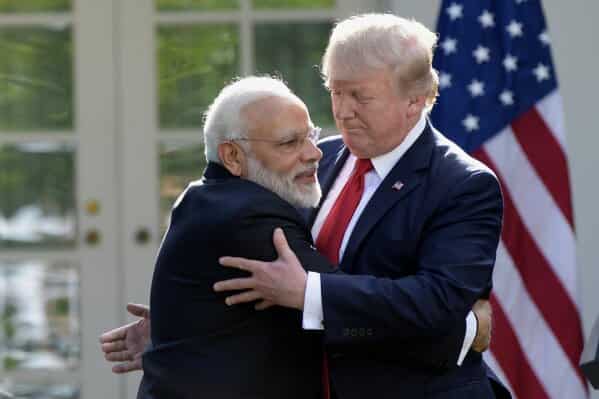
Indian and American officials will conduct three -day conversations from April 23 in Washington for a commercial pact of proposals with terms of references (Tor) that cover around 19 chapters such as rates, non -tariff barriers and customs facilitation, official sources said.
The official Indian team is visiting the US to give more impulse to the negotiations in the 90 -day rate pause window and discuss to iron the differences on certain issues before formally launching conversations for the Bilateral Commercial Agreement (BTA).
The main negotiator of India, additional secretary of the Department of Commerce, Rajesh Agrawal, will lead the team for the first inpersonal conversations between the two countries. Agrawal was appointed secretary of the Next Commerce on April 18. Will assume the position as of October 1.
“Both parties will discuss the level of ambition. The tors will develop and discuss. PACT will be discussed, in addition to the programming, so that things can end in 90 days.
The Three-Day Deliberations Assume Mean “Win-Win” For “Win-Win” For “Win-Win” For “Win-Win” For “Win-Win” For “Win-Win” For “Win-Win” For “Win-Win” For “Win-Win” to “win” win-win “win” win “win” win-win “win-win” win-win “win” win “win” win “win” win “win” win “win” win ” “Win” win-win “win-win” win “win”
In the language of international trade, the level of ambition refers to the extent to which two countries are willing to commit to specific trade liberalization measures.
The visit also follows the high hero of conversations at the official level between the two countries last month.
Brendan Lynch, the United States Assistant Commercial Representative for Asia Sur and Central, was in India from March 25 to 29 for crucial commercial discussions with Indian officials.
The two parties are interested in using the 90 -day rate pause, announced by the president of the United States, Donald Trump, on April 9, to boost the conversations.
On April 15, the Secretary of Commerce, Sunil Barthwal, had declared that India will try to close the negotiations as quickly as possible with the United States.
India and the United States have dedicated themselves to negotiating a bilateral commercial agreement since March. Both parties have been aimed at concluding the first phase of the Pact for Autumn (September-ETIL) of this year, with the aim of duplicating more from bilateral trade to USD 500 billion by 2030, from approximately USD 191 billion, currently.
In a commercial pact, two countries reduce or eliminate customs tariffs in the maximum number of negotiated goods between them. They also relieve the rules to promote services and increase investments.
While the United States is analyzing service concessions in sectors such as certain industrial products, cars (participularly electric vehicles), wines, petrochemical products, dairy and agricultural items such as apple, tree nuts and alfalfa hay; India can analyze work cuts for labor intensive sectors such as clothing, textiles, gems and jewelry, leather, plastics, chemicals, oil seeds, shrimp and horticulture products.
From 2021-22 to 2024-25, the United States was the largest commercial partner in India. In the last fiscal year, India exports to the US increased by 11.6 percent to USD 86.51 billion compared to USD 77.52 billion in 2023-24. Imports increased by 7.44 percent by 2024-25 to USD 45.33 billion against USD 42.2 billion in 2023-24. With the United States, India had a commercial surplus (the difference between imports and exports) or USD 41.18 billion in goods in 2024-25.
The United States represented almost 19.78 or total exports of India and 6.29 percent of total imports. To address GAP and Boost manufacturing, the Trump administration announced tariffs on April 2, including 26 percent in India. He was later suspended for 90 days until July 9.
In 2024, India’s Main Exports to the us included drarug formals and biological (USD 8.1 billion), Telecom Instruments (USD 6.5 billion), Priceus and Semi-Precious Stones (USD 5.3 Billion), Petroleum Products (USD 4.1 billion), Goldeum), Goldeum Jet Golion), Billion), Billion), Billion), Billion), Billion), Billion), Billion), Billion), Billion) Billion), Billion), Billion), one billion), one billion), one billion), one billion), one billion), one billion), one billion), one billion), one billion! 3.2 billion), cotton garments lists, including accessories (USD 2.8 billion) and iron and steel products (USD 2.7 billion).
IMPORTS INCUDED CRUDE OIL (USD 4.5 BILLION), PETROLEUM PRODUCTS (USD 3.6 BILLION), COAL, COKE (USD 3.4 BILLION), CUT AND POLISHED DIAMONDS (USD 2.6 BILLION), ELECTRIC MACHINAR (USD 1.4 BILLION), AIRCRAFT, AND Spaccraft, and and Sparcraffe, and and Sparcraffe, and and Sparcraffe, and Sparcraft, and Spaccraft, and Sparcrafff, and Spaccraft, and Spacraffef, and Spacraffef, and Spaccraft Billion).