




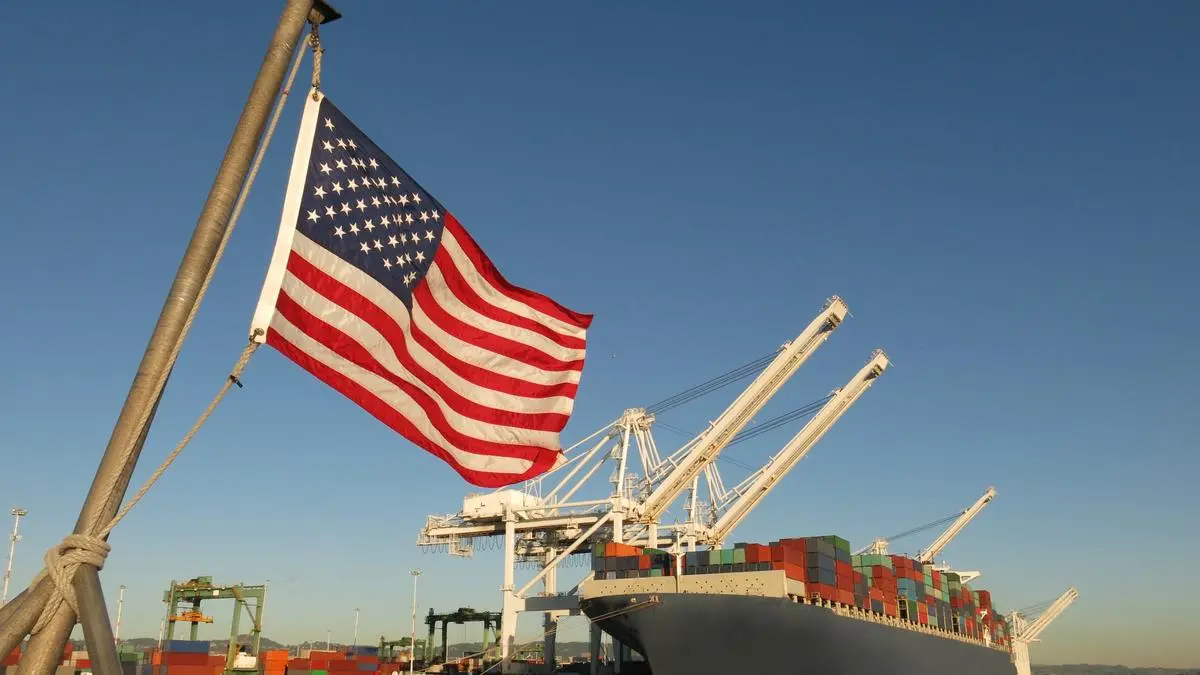

Commerce is likely to deviate from uncertain commercial partners due to improved bilateral commercial costs | Photo credit: Amyl Aughinghouse
The announcement of the “reciprocal” rates of the Trump administration on April 2, 2025, has created a Schrödinger cat situation, a state of flow, uncertainty and paradox. The subsequent retaliation of China and the EU, the 90 -day break to the imposition of 10 percent rates above the base by the United States a week later, and the EU that remains in its own retaliation tariffs is creating enormous uncertainty in commercial policy. This exhibition issue not only in China, the EU and the United States but in countries around the world.
The specific uncertainty of the country affects unilaterally and asymmetric the production capacity of companies in exporting countries and demand in importing countries, which impacts both exports and imports.
The increase in uncertainty also has a direct relationship with bilateral commercial costs through increases in contractual uncertainty; Increased uncertainties on the border; And/or through regulatory changes that can improve bilateral transport costs, all of which probably prevent trade. For example, the global freight industry has been witnessing fluctuations in shipping costs, induced by the current uncertainty of commercial policy.
Hesitant to trade
Drewry’s world container index increased 3 percent to $ 2,265 per 40 -foot container on April 10. Given the uncertainty about future regulations, rates and/or agents, economic agents can also hesitate to trade with the observation to adopt. Corroborating this, the US exhibitors currently rush the orders in question given the 90 -day pause in the rates.
The increase induced by uncertainty in inventory costs for foreign supplies can also lead to greater reduction in foreign orders in relation to national orders, resulting in a replacement of imports with national production. This explains half the great commercial collapse of 2008-09.
Changes in tariff/regulatory regimes can also affect the decision at the company’s level to participate in international trade. Companies can reduce the fixed investment required to enter new markets. Therefore, uncertainty in destination markets can result from both commercial destruction and commercial deviation of more than uncertain countries. In fact, a Document of Meredith Crowley and co -authors shows that threats also threaten to raise tariffs in the future (“scares”) have ads at the entrance to new markets, even when the threatened import tariffs do not materialize.
Uncertainty is also associated with an indirect effect on the general commercial costs of exporters and importers fish All commercial partners. Therefore, trade is likely to deviate from uncertain commercial partners due to improved bilateral commercial costs; At the same time, trade is likely to be believed among more “safe” business partners. Supporting this, it has been found that the uncertainty induced by Brexit diverts trade away from the United Kingdom and “creates” more commerce between EU Reminal Member States.
Finally, the episodes of uncertainty also alter the expectations of consumers and commercials, promoting changes in exchange rates, which in turn impact commercial flows. Illustratively, Brexit has been one of the key factors that drive the volatility of the British pound against the main currencies since the last five years. The most volatile exchange rates induce greater bilateral trade with commercial partners with more stable exchange rates. An increase in the uncertainty of commercial policy can also induce an increase in precaution in marking, resulting in reduced investment and production, especially by exporting companies.
For all these reasons, the current uncertainty in commercial policy is not only a great buffer in the propensations of companies and countries to commerce and in their volume of commerce, but also in investment as supply chains and stock markets are interrupted.
The writer is professor, finance and economy, Spjimr, Mumbai, and visiting Fellow, Center for Social and Economic Progress, Nueva Delhi. The views are personal
Posted on April 22, 2025