




President Donald Trump is under opposing pressure from inside Israel and his own MAGA base as he ponders the most fateful national security decision of either of his presidencies — whether to attempt a killer blow against Iran’s nuclear program.
Israel is sending clear signals, including through former senior officials, that it hopes the US will ultimately join the conflict and use its unique military edge to destroy the Iranian nuclear complex at Fordow, which is buried deep underground.
“We believe that the United States of America and the president of the United States have an obligation to make sure that the region is going to a positive way and that the world is free from Iran that possesses (a) nuclear weapon,” former Israeli Defense Minister Yoav Gallant told in an interview.
Israeli Prime Minister Benjamin Netanyahu, meanwhile, to pour cold water on a diplomatic channel with Iran that Trump seems desperate to revive, saying it had been used to “string the US along.”
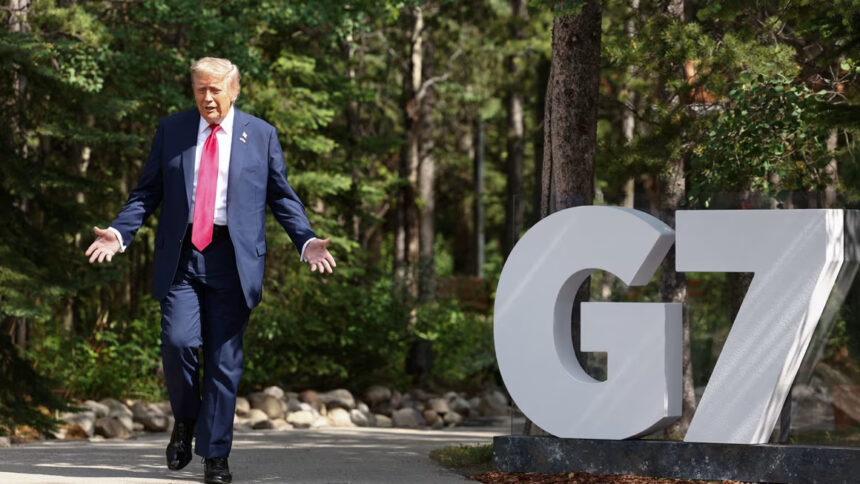
A sense that an entwined political and national security crisis is building was exacerbated by Trump’s decision to suddenly leave the G7 summit in western Canada on Monday night.
“I have to be back early for obvious reasons,” Trump said. “They understand. This is big stuff.”
He flies home to Washington as it reverberates with blunt warnings from some of the most influential opinion shapers in MAGA media. Personalities like Steve Bannon and Tucker Carlson say that a decision to strike Iran would represent a repudiation of his 10-year-old political movement and “America First” principles. ”I don’t want the US enmeshed in another Middle East war that doesn’t serve our interests,” Carlson said on Bannon’s “War Room” show on Monday.
Synergy between right and left populist movements in America is also on display. Vermont independent Sen. Bernie Sanders, who ran as a Democrat primary candidate in the 2016 and 2020 elections, said the US “must not get dragged into another of Netanyahu’s wars.”
Loud voices opposed to deeper US involvement underscore the painful legacy of the Iraq and Afghan wars, which created political forces that nurtured Trump’s populist uprising. But the neoconservative interventionist wing of the GOP has not disappeared. Hawks like Sen. Lindsey Graham are trying to convince Trump that Israel’s blitz against Iranian air defenses and a confluence of forces that have weakened the regime offer the US a chance to definitively end the nuclear aspirations of its 45-year foe and to transform the Middle East.
European leaders who met Trump in Canada brought to bear their own pressure, seeking to see whether the US will rein in Netanyahu amid concern over Trump’s suggestion that Russian President Vladimir Putin might join a peace effort.
Even Iran joined the cacophony, accusing Israel of sabotaging US nuclear talks with the Islamic Republic, a centerpiece of the president’s so far frustrated strategy of branding himself as a global peacemaker.
A decision that will define Trump’s presidency … and much more
Multiple voices bearing down on Trump reflect the gravity of a decision that will carry consequences that go beyond the always-heavy burden of whether to send American personnel to war.
Whatever he decides, Trump will set off consequences that will be pivotal for Israel’s security, the wider Middle East, and US power and influence. He can’t know whether a US attack on subterranean chambers in Fordow could succeed or whether it will suck the US deeper into a prolonged conflict.
Historically, Trump has balked at perceptions that his options are being narrowed — or that others are trying to make up his mind for him. So pressure from any direction risks being counterproductive.
Ironically, Trump set up this dilemma himself. His decision to walk away from a previous US nuclear deal with Iran in his first term delighted Israel — but laid the groundwork for a future crisis.
The raging debate in the MAGA movement that is splitting conservative media is a sign that Trump’s own support base is on the line, and that a legacy he promised would not be marked by foreign interventionism is also at stake.
Trump often creates shock and disorientates opponents by igniting confrontations that he later defuses or postpones. This is his preferred approach to trade wars. But there would be no going back from a US military strike with bunker-busting bombs at Fordow. Whatever the aftermath, the president would own it.
This may explain why he avoided committing himself to any course of action on Monday. He said Iran has “to make a deal” and should talk immediately “before it is too late.” But pressed by reporters on what would cause a direct US intervention in the conflict, he replied, “I don’t want to talk about that.”
Perhaps Trump is just playing for time or trying to scare Tehran back to the table. But maybe he really doesn’t know what he’s going to do.